Build Space Invaders in the Browser: A 1978 Arcade Classic with Phaser
Build Space Invaders in the Browser: A 1978 Arcade Classic with Phaser
There’s something magical about Space Invaders. While Breakout and Asteroids teach fundamental mechanics, Space Invaders introduces the strategic depth that made arcade gaming a cultural phenomenon. The descending alien grid, degrading shields, and escalating wave progression create a perfect storm of tension and replayability.
This build took about 2 hours with AI assistance. Here’s the entire process.
Why Space Invaders After Breakout and Asteroids?
Space Invaders builds on collision detection, movement systems, and score tracking — but adds layers of complexity that make it a richer engineering challenge. The original Space Invaders (1978) by Tomohiro Nishikado introduced the concept of an “invading force” that gets faster as you eliminate aliens, creating natural difficulty progression without complex AI.
Unlike Breakout’s single moving ball, Space Invaders requires managing a grid of 55 individual entities with shared movement logic. It’s the first real test of building systems that work together cohesively.
Game Design Decisions
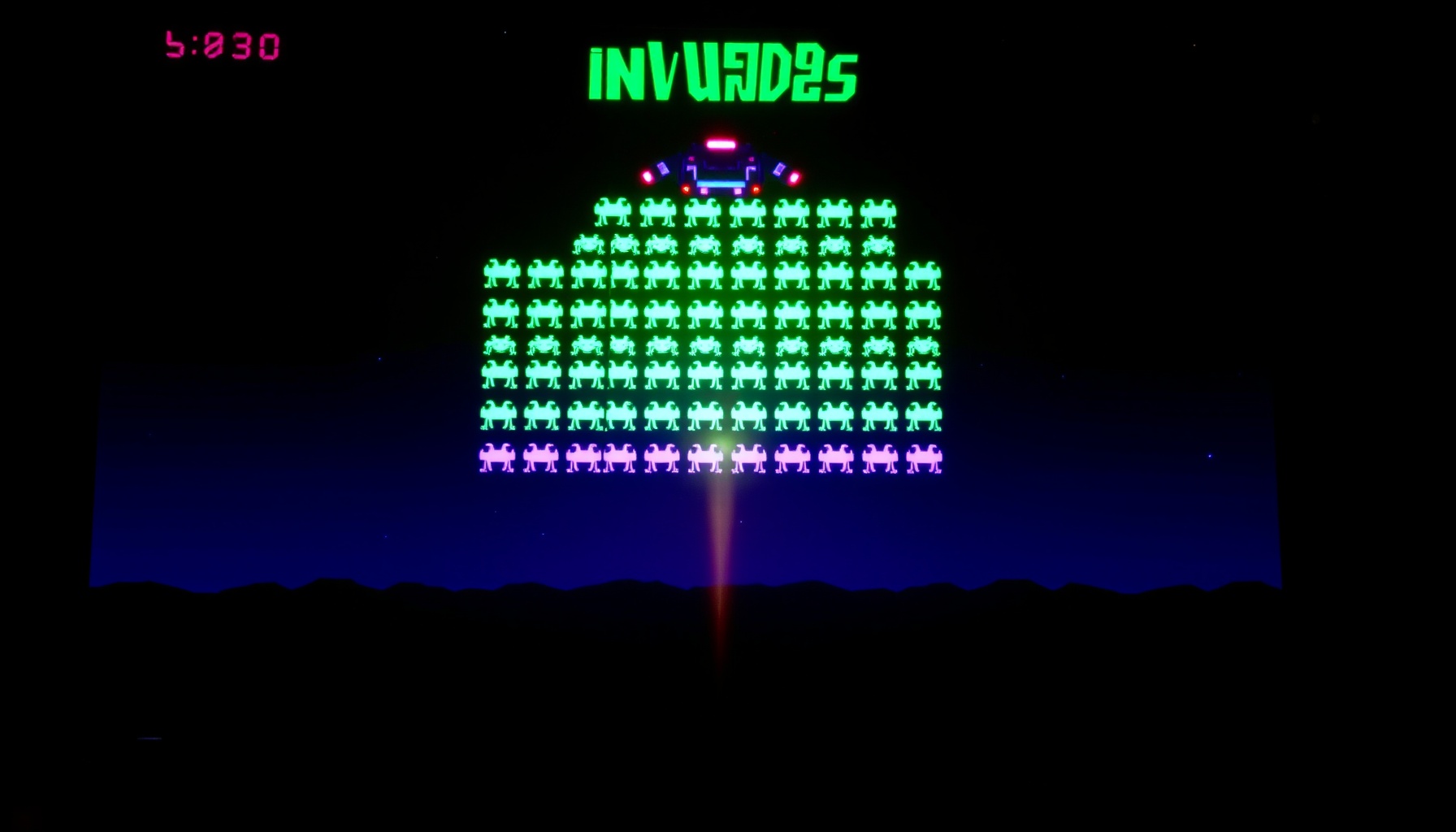
The game design hinges on three systems: alien grid movement, shield degradation, and wave progression. The grid holds 55 aliens in 5 rows and 11 columns — the same formation as the original 1978 cabinet (Wikipedia) — while bunkers erode block-by-block and speed scales with each wave.
The Alien Grid Movement System
The most distinctive feature is the grid formation movement. My implementation uses a group of 55 aliens arranged in 5 rows and 11 columns — the same grid as the original 1978 cabinet (Wikipedia) — each drawn using Phaser’s graphics API, no sprite sheets needed. The classic alien designs were constrained by 1978 hardware: the game ran on an Intel 8080 CPU at 2MHz, which could only manage simple 8-bit sprites (Wireframe #9).
The movement algorithm is elegantly simple:
moveAliens() {
    let hitEdge = false;
    this.aliens.children.each(alien => {
        if (!alien.active) return;
        const nextX = alien.x + this.alienDir * 12;
        if (nextX > W - 30 || nextX < 30) hitEdge = true;
    });

    this.aliens.children.each(alien => {
        if (!alien.active) return;
        if (hitEdge) alien.y += 16;
        else alien.x += this.alienDir * 12;
    });

    if (hitEdge) this.alienDir *= -1;
}
Check all aliens’ positions before moving any of them. If any would hit the edge, the whole group drops down and reverses. This creates the signature “marching” effect that made the original iconic. The speed multiplier increases difficulty as aliens die — fewer aliens means faster movement, creating natural tension. In the original arcade cabinet this acceleration was actually a hardware accident: the 8080 CPU could only update one alien per frame, so fewer aliens meant faster updates (Wireframe magazine).
Shield Degradation System
Bunkers add strategic depth. Rather than a simple health counter, this build constructs each bunker from individual 4×4 pixel blocks using a shape template:
const shape = [
    '  XXXXXX  ',
    ' XXXXXXXX ',
    'XXXXXXXXXX',
    'XXXXXXXXXX',
    'XXXXXXXXXX',
    'XXX    XXX',
    'XX      XX'
];
Each block is a separate physics sprite. When a bullet hits a block, only that block is destroyed — creating organic, chunky erosion similar to the original hardware behavior. In the original cabinet, whenever a shot’s explosion sprite overlapped a shield, the shield pixels were deleted along with it — hardware behavior that designers turned into a beloved gameplay feature.
Wave Progression and Difficulty Scaling
Each wave increases base alien speed and starts the grid lower on the screen. The formula Math.max(100, 800 - wave * 40) ensures a minimum 100ms step interval while gradually increasing speed. Combined with score-based acceleration during waves, this creates that classic “just one more try” feeling that well-designed difficulty curves achieve.
Code Walkthrough
The code walkthrough covers collision groups, invulnerability frames, and touch controls. Phaser’s arcade physics overlap method detects projectile hits without physical push-apart — separating player bullets, alien bullets, aliens, and bunkers into distinct groups — and is more efficient than collide for projectile-based games (Phaser Arcade Physics).
Collision Groups with Phaser Physics
Phaser’s arcade physics handles collision detection through groups. Separate groups for player bullets, alien bullets, aliens, and bunkers keep things organized:
this.physics.add.overlap(this.playerBullets, this.aliens,
    this.bulletHitAlien, null, this);
this.physics.add.overlap(this.playerBullets, this.bunkers,
    this.bulletHitBunker, null, this);
this.physics.add.overlap(this.alienBullets, this.player,
    this.alienHitPlayer, null, this);
this.physics.add.overlap(this.alienBullets, this.bunkers,
    this.bulletHitBunker, null, this);
The overlap method is perfect here — we want to detect when bullets touch things, not physically push them apart. This is more efficient than collide for projectile-based games (Phaser Arcade Physics).
Invulnerability Frames
After getting hit, the player gets 2 seconds of invulnerability with a flashing effect:
this.playerInvulnerable = true;
this.player.setAlpha(0.3);
this.time.addEvent({
    delay: 150, repeat: 12,
    callback: () => {
        this.player.alpha = this.player.alpha < 0.5 ? 1 : 0.3;
    }
});
this.time.delayedCall(2000, () => {
    this.playerInvulnerable = false;
    this.player.setAlpha(1);
});
This pattern — borrowed from classic arcade design — prevents frustrating instant-death chains while giving clear visual feedback that the player is protected.
Touch Controls for Mobile
The game supports both keyboard and touch input. Touch divides the screen into left/right halves for movement, with taps firing bullets:
this.input.on('pointerdown', (p) => {
    if (p.x < W / 2) this.touchLeft = true;
    else this.touchRight = true;
    this.playerShoot();
});
This dual-input approach means the game works on phones and tablets without any additional configuration.
AI Development Process
Building Space Invaders with AI assistance revealed effective prompting strategies for AI-assisted game development. The winning approach broke the project into discrete, testable components — player movement, alien grids, collisions, shields, and wave progression — prompting for one mechanic at a time instead of requesting a complete game in a single shot.
Iterative Development Cycles
Instead of asking for “a complete Space Invaders game,” I broke the project into discrete, testable components:
- Player movement and shooting — get the basics working first
- Alien grid creation and marching movement — the core mechanic
- Collision detection and scoring — make it a game
- Shield systems with block-level degradation — add strategy
- Wave progression and UFO mechanics — add depth
Each prompt included the specific mechanic, how it integrates with existing code, and expected behavior. This cycle took about 10-15 minutes per feature.
Prompting Strategy
Specific prompts yield better results than vague requests. Instead of “make aliens move,” I asked: “Implement alien grid movement where aliens move horizontally until hitting screen edges, then drop down 16 pixels and reverse direction. Check all positions before moving any alien.”
The AI understood coordinated movement and edge detection, generating clean code that handled both cases. The key insight: describe the behavior, not the implementation.
What You Learned
This build’s core lesson is that a complete, playable arcade classic can be assembled from a handful of reusable Phaser patterns, with generateTexture() drawing all pixel art procedurally instead of loading sprite sheets (Phaser Graphics API). The finished game runs in the browser with keyboard and touch controls.
- Group-based entity management — Using Phaser physics groups to manage 55+ entities efficiently without individual references
- State machines — Game states (playing, game over, wave transition) with clean transitions
- Difficulty scaling — Dynamic speed adjustments based on remaining aliens and current wave
- Dual input handling — Keyboard and touch input for cross-platform play
- Physics overlap detection — Phaser’s
overlapfor projectile collisions vscollidefor physical interactions - Procedural texture generation — Drawing pixel art with
generateTexture()instead of loading sprite sheets (Phaser Graphics API)
The complete game is playable right here in your browser. Try it on mobile too — the touch controls work for both movement and shooting.
Next Steps
Now that you’ve mastered Space Invaders, natural extensions include high-score persistence with localStorage (MDN), new alien movement patterns like zigzag and dive attacks, power-ups such as rapid fire and shield repair, and a boss wave every five levels — each building directly on the systems this build introduced.
- Add high score persistence using
localStorage - Implement different alien movement patterns (zigzag, dive attacks)
- Add power-ups (rapid fire, multi-shot, shield repair)
- Create a boss wave every 5 levels with a larger alien
Space Invaders is simple enough to complete in an afternoon but deep enough to teach real game development concepts. Whether you’re using AI assistance or coding from scratch, it’s an essential addition to any game developer’s portfolio.